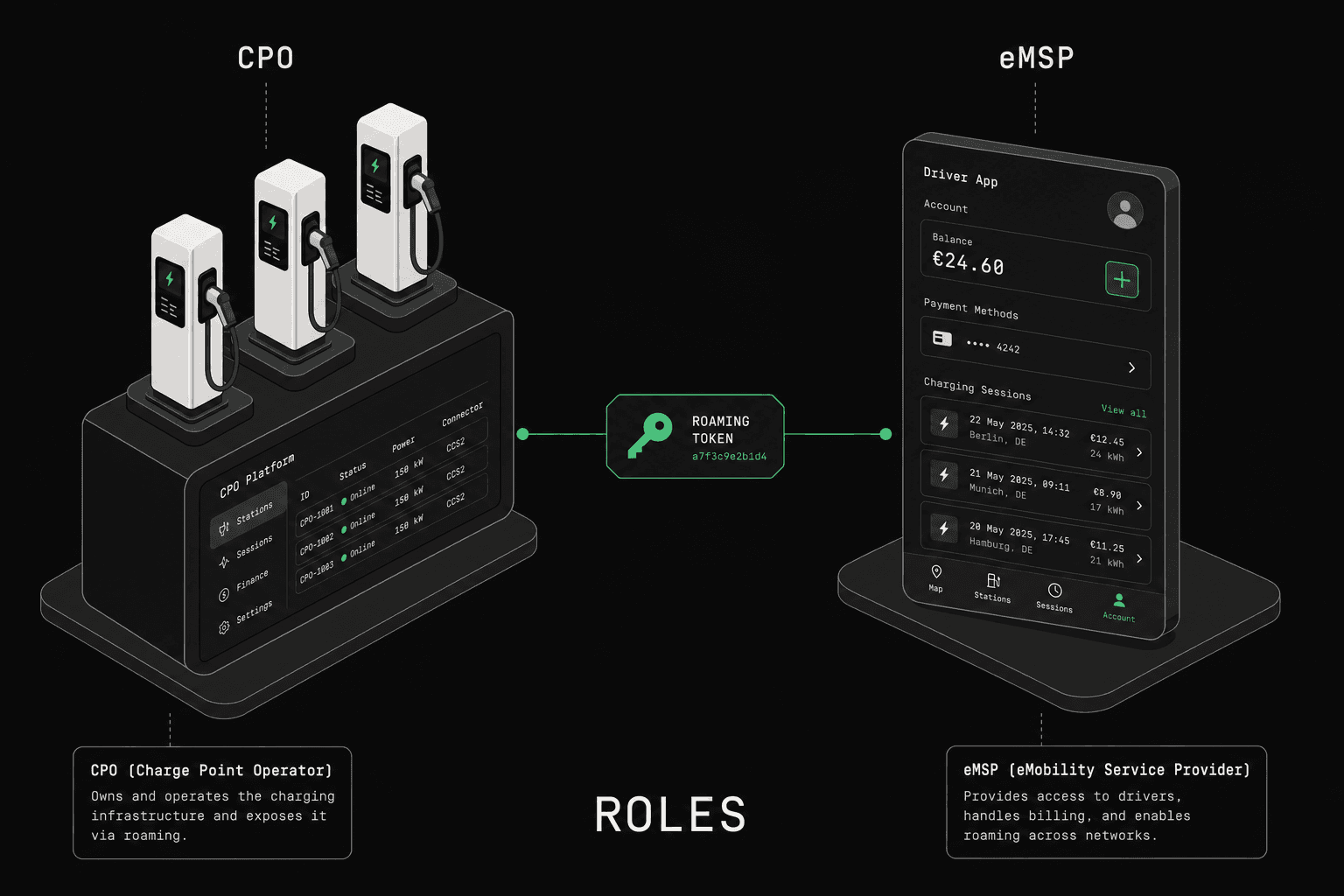
Quick answer: A CPO (Charge Point Operator) owns, installs, and operates physical EV charging stations and their CPMS backend, while an eMSP (e-Mobility Service Provider) is the customer-facing layer giving drivers apps, authentication, billing, and roaming access. They connect through the OCPI protocol, and a single company can act as both.
The EV charging ecosystem has two fundamental roles: CPO (Charge Point Operator) and eMSP (e-Mobility Service Provider). Understanding the difference is essential for anyone building, operating, or integrating with charging infrastructure.
CPO: Charge Point Operator
A CPO owns, installs, and operates physical EV charging stations. They are responsible for:
- Hardware: Purchasing, installing, and maintaining chargers
- Network Operations: Monitoring uptime, handling faults, scheduling maintenance
- Grid Connection: Managing electrical infrastructure and grid integration
- CPMS Management: Running the CPMS backend that controls chargers via OCPP, the Open Charge Alliance communication standard
- Location Management: Securing sites, managing access, signage
CPO Examples
- Fastned (Netherlands) — Operates highway fast-charging stations
- IONITY (Europe) — Joint venture operating ultra-fast chargers across Europe
- ChargePoint (US) — Both CPO and eMSP, operating an extensive US charging network
- Allego (Europe) — Pan-European charging network operator
- EVgo (US) — Operates DC fast charging stations
eMSP: e-Mobility Service Provider
An eMSP provides EV drivers with access to charging stations. They are the customer-facing layer:
- Driver Apps: Mobile applications for finding, starting, and paying for charging
- Authentication: RFID cards, app-based tokens, Plug & Charge certificates (ISO 15118-20)
- Billing: Processing payments, subscriptions, and invoice generation
- Roaming: Enabling access to multiple CPO networks via OCPI, the EVRoaming Foundation standard
- Customer Support: Handling driver inquiries and disputes
eMSP Examples
- Plugsurfing — Aggregates multiple charging networks into one app
- NewMotion (Shell Recharge) — Provides roaming access across Europe
- Chargemap — French eMSP with pan-European coverage
- Electromaps — Spanish eMSP expanding across Southern Europe
What Are the Key Differences Between CPO and eMSP?
| Aspect | CPO | eMSP |
|---|---|---|
| Core Asset | Physical chargers | Customer relationships |
| Revenue Model | Energy sales, site fees | Service fees, subscriptions |
| Technology | CPMS + OCPP | Driver app + OCPI |
| Customer | Site owners, grid operators | EV drivers |
| Key Metric | Uptime, utilization rate | Active users, sessions |
| Capex | High (hardware + installation) | Low (software-based) |
How Do CPOs and eMSPs Work Together?
The connection between CPOs and eMSPs happens via the OCPI protocol:
- CPO publishes charger locations, availability, and pricing via OCPI
- eMSP pulls this data and shows it to drivers in their app
- Driver selects a charger and requests to start charging
- eMSP sends authorization token to CPO via OCPI
- CPO validates and starts the charging session via OCPP
- After charging, CPO sends a CDR (Charge Detail Record) to eMSP
- eMSP bills the driver, then settles with the CPO
Can a Company Be Both CPO and eMSP?
Yes — and many are. Companies like ChargePoint, Tesla, and Shell Recharge operate as both:
- As CPO: They operate their own charging stations
- As eMSP: They provide driver-facing apps and roaming access
This vertical integration simplifies the user experience but can limit interoperability if not connected to roaming networks.
How Do You Test CPO and eMSP Integrations?
Building or integrating CPO/eMSP functionality requires testing:
- OCPP flows (CPO side): Charger communication, authorization, smart charging
- OCPI flows (Roaming): Location sharing, session management, CDR exchange
- End-to-end scenarios: Driver authenticates via eMSP app → CPO starts charging
OCPPLab supports both OCPP and OCPI testing, letting you simulate the full charging ecosystem — from charger to CPMS to roaming hub — without any physical infrastructure.