Quick answer: The best OCPP emulator depends on what you need to validate. Choose a cloud platform to simulate thousands of chargers against a CPMS for repeatable regression and load testing, an open-source library for code-level control inside automated tests, or a lightweight mobile or desktop tool for single-charge-point smoke tests and field diagnostics.
The best OCPP emulator depends on what you actually need to validate. Some teams need a cloud platform that can simulate thousands of chargers against a CPMS. Others need an open-source library they can script inside automated tests. Others only need a single-charge-point utility for smoke tests and field diagnostics.
If you need version-specific validation first, go to OCPP 1.6 testing or OCPP 2.0.1 testing.
If you are actively comparing tools for a live project, see platform features, CPMS testing, or pricing.
Quick Answer
Choose a cloud OCPP emulator if you need:
- many concurrent virtual charge points
- repeatable CPMS regression testing
- load testing
- buyer-ready reporting and faster setup
Choose an open-source OCPP emulator or library if you need:
- full code-level control
- custom message generation
- deep integration into an existing engineering workflow
- lower software cost and higher internal maintenance effort
Choose a lightweight mobile or desktop emulator if you need:
- one charger at a time
- quick smoke tests
- simple field validation
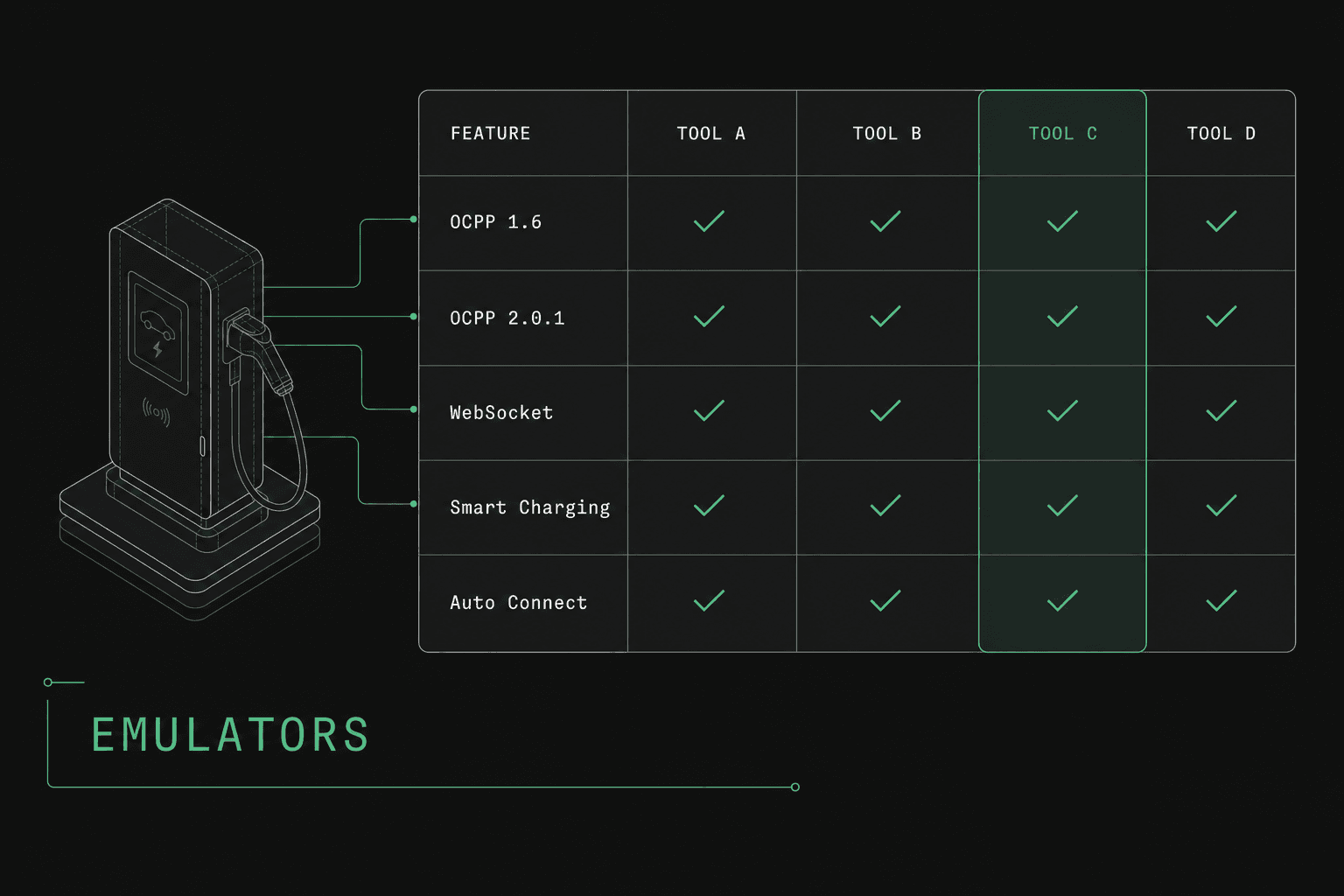
Comparison Table
| Emulator Type | Best For | OCPP 1.6 | OCPP 2.0.1 | Scale | Setup Effort |
|---|---|---|---|---|---|
| Cloud platform | CPMS QA, load testing, release validation | Yes | Yes | High | Low |
| Open-source library | Custom engineering and protocol edge cases | Yes | Usually yes | Medium | High |
| Open-source CPMS/test stack | Development labs and protocol exploration | Yes | Mixed | Medium | Medium to high |
| Field/mobile emulator | Smoke tests and technician workflows | Yes | Often limited | Low | Low |
What Makes a Good OCPP Emulator?
The best OCPP emulator is not just the tool that can send a BootNotification. As defined by the Open Charge Alliance, OCPP covers far more than the happy path, so a good emulator should help you validate the behaviors that actually break in production:
- reconnect logic
- heartbeat timing
- authorization and transaction flows
- meter value cadence
- status transitions
- remote commands
- malformed payload and timeout handling
- mixed protocol version support
If you are testing a commercial CPMS, an emulator that only handles the happy path is not enough.
When Should You Use a Cloud OCPP Emulator?
Cloud platforms are the fastest path when the goal is CPMS validation at scale. They are generally strongest at:
- multi-charger simulation
- repeatable QA
- performance and load testing
- shared visibility for engineering, QA, and product teams
They also tend to be the most practical option when you need both OCPP 1.6 testing and OCPP 2.0.1 testing without building all the protocol machinery yourself.
Best for
- CPMS vendors
- charge point management teams
- QA and release engineering
- pre-production performance testing
Tradeoffs
- subscription cost
- less low-level code control than a custom library
When Should You Use an Open-Source Library?
Open-source libraries are the right choice when your team wants full control over the emulator behavior and is willing to own the engineering work that comes with it.
They are useful when you need to:
- script unusual message sequences
- generate malformed or adversarial payloads
- embed emulator logic directly in a test suite
- prototype protocol behavior quickly in code
Best for
- protocol engineers
- backend developers
- teams with strong internal test-automation capability
Tradeoffs
- more code to maintain
- no managed scale by default
- weaker dashboards and reporting unless you build them yourself
When Should You Use an Open-Source Test Stack?
Some teams prefer a broader open-source environment that helps them understand protocol behavior end to end. These stacks can be useful for:
- lab exploration
- interoperability debugging
- reference behavior during development
They can be valuable, but they usually require more time to install, configure, and keep aligned with your production needs.
When Should You Use a Lightweight Field Emulator?
Lightweight emulators are good for:
- checking whether a CPMS endpoint is reachable
- verifying a small number of core message flows
- basic commissioning and support workflows
They are usually not the right choice for serious regression or scale testing, but they are useful to keep in the toolbox.
How Do You Choose the Best OCPP Emulator?
Choose a cloud emulator if:
- your CPMS must handle many concurrent chargers
- you need to run repeatable test suites before releases
- you need load testing and regression testing in one place
- you want non-developers to use the tool as well
Choose an open-source emulator if:
- your team prefers code over UI
- you need custom test logic and message injection
- you are comfortable owning infrastructure and maintenance
- your test scope is specialized enough that generic tooling is not sufficient
Choose a field emulator if:
- your scope is single-device smoke testing
- you want instant setup
- you do not need automation or scale
Best OCPP Emulator by Use Case
| Use Case | Best Emulator Type |
|---|---|
| CPMS release regression | Cloud platform |
| OCPP load testing | Cloud platform |
| Custom protocol edge-case generation | Open-source library |
| Field smoke tests | Lightweight emulator |
| Learning OCPP internals | Open-source library or reference stack |
How Do OCPP 1.6 and 2.0.1 Emulator Needs Differ?
Not every emulator is equally strong across versions.
For OCPP 1.6
You should expect good coverage of the core OCPP 1.6 specification messages for:
- BootNotification
- Heartbeat
- StatusNotification
- Authorize
- StartTransaction
- MeterValues
- StopTransaction
- remote commands such as reset and remote start
For OCPP 2.0.1
You should expect support for the OCPP 2.0.1 specification workflows:
- TransactionEvent
- smart charging flows
- device model or variable handling
- higher-security and certificate-aware behaviors
- richer error-path testing
If the emulator only claims “OCPP 2.0.1 support” without clear workflow depth, inspect it carefully before depending on it.
What Should Buyers Check Before Choosing?
Use this checklist:
- Does it support both OCPP 1.6 and OCPP 2.0.1?
- Can it reproduce realistic charger state transitions?
- Can it simulate large numbers of concurrent charge points?
- Does it support failure injection and reconnect behavior?
- Can QA, product, and engineering all use it?
- Does it help with CPMS testing and OCPP load testing?
- Can it fit into CI/CD and recurring release validation?
Why Choose OCPPLab as Your OCPP Emulator?
OCPPLab is designed for teams that want a cloud-based OCPP emulator for commercial CPMS testing rather than a code-only toolkit. It is strongest when the job is to:
- simulate many chargers at once
- validate release candidates quickly
- test OCPP 1.6 and OCPP 2.0.1 in one platform
- combine emulator coverage with roaming and backend QA workflows
That makes it a better fit for operational testing than lightweight or single-device tools, especially when the site under test needs realistic concurrency rather than one perfect happy-path session.
For a broader tooling comparison, see best OCPP testing tools compared.
Frequently Asked Questions
What is the difference between an OCPP simulator and an OCPP emulator?
In practice, teams often use the words interchangeably. A simulator usually focuses on generating protocol behavior, while an emulator aims to mimic more of the real charger state model and runtime behavior.
What is the best OCPP emulator for CPMS teams?
Usually a cloud-based emulator platform, because CPMS teams care about repeatability, concurrency, regression coverage, and release confidence more than single-device manual tests.
Can I use an open-source emulator for load testing?
Yes, but you will usually need to build orchestration, observability, and scaling around it. That is the main tradeoff.
Do I need separate emulators for OCPP 1.6 and OCPP 2.0.1?
Not necessarily. A good platform can support both, but you should still validate version-specific workflows independently.