Quick answer: This glossary defines 50+ EV charging terms developers need, spanning protocols like OCPP and OCPI, roles like CPO, CPMS, and eMSP, plus concepts like AC and DC charging, authorization, CDRs, smart charging, and ISO 15118 Plug and Charge. It's a quick reference whether you're building a CPMS, deploying chargers, or developing a driver app.
The EV charging industry has its own vocabulary. Whether you're a developer building a CPMS, a CPO deploying chargers, or an eMSP building a driver app, this glossary covers every term you need to know.
A
AC Charging
Charging an EV using alternating current. The vehicle's onboard charger converts AC to DC. AC delivers lower power than DC, which generally suits longer dwell times such as home, workplace, or overnight charging. Also called Level 1 (120V) or Level 2 (240V) charging in North America.
AFIR (Alternative Fuels Infrastructure Regulation)
EU regulation requiring member states to deploy public EV charging infrastructure along major highways. Mandates ad-hoc payment access at all public chargers.
Authorization
The process of verifying whether an EV driver is allowed to use a charging station. Methods include RFID cards, mobile apps, Plug and Charge (ISO 15118), and credit card terminals.
B
BootNotification
The first OCPP message a charger sends when connecting to a CPMS. Contains the charger's vendor, model, serial number, and firmware version. The CPMS responds with an accepted/rejected status and a heartbeat interval.
C
CDR (Charge Detail Record)
A record of a completed charging session used for billing. Contains start time, end time, energy delivered, costs, and authentication details. Exchanged between CPO and eMSP via OCPI.
Connector
The physical plug on a charging station. Common types: Type 1 (J1772), Type 2 (Mennekes), CCS1, CCS2, CHAdeMO, Tesla NACS.
CPO (Charge Point Operator)
The company that owns and operates physical EV charging stations. Responsible for hardware, maintenance, and network operations.
CPMS (Charge Point Management System)
Older term for CPMS. See CPMS.
CPMS (Charging Station Management System)
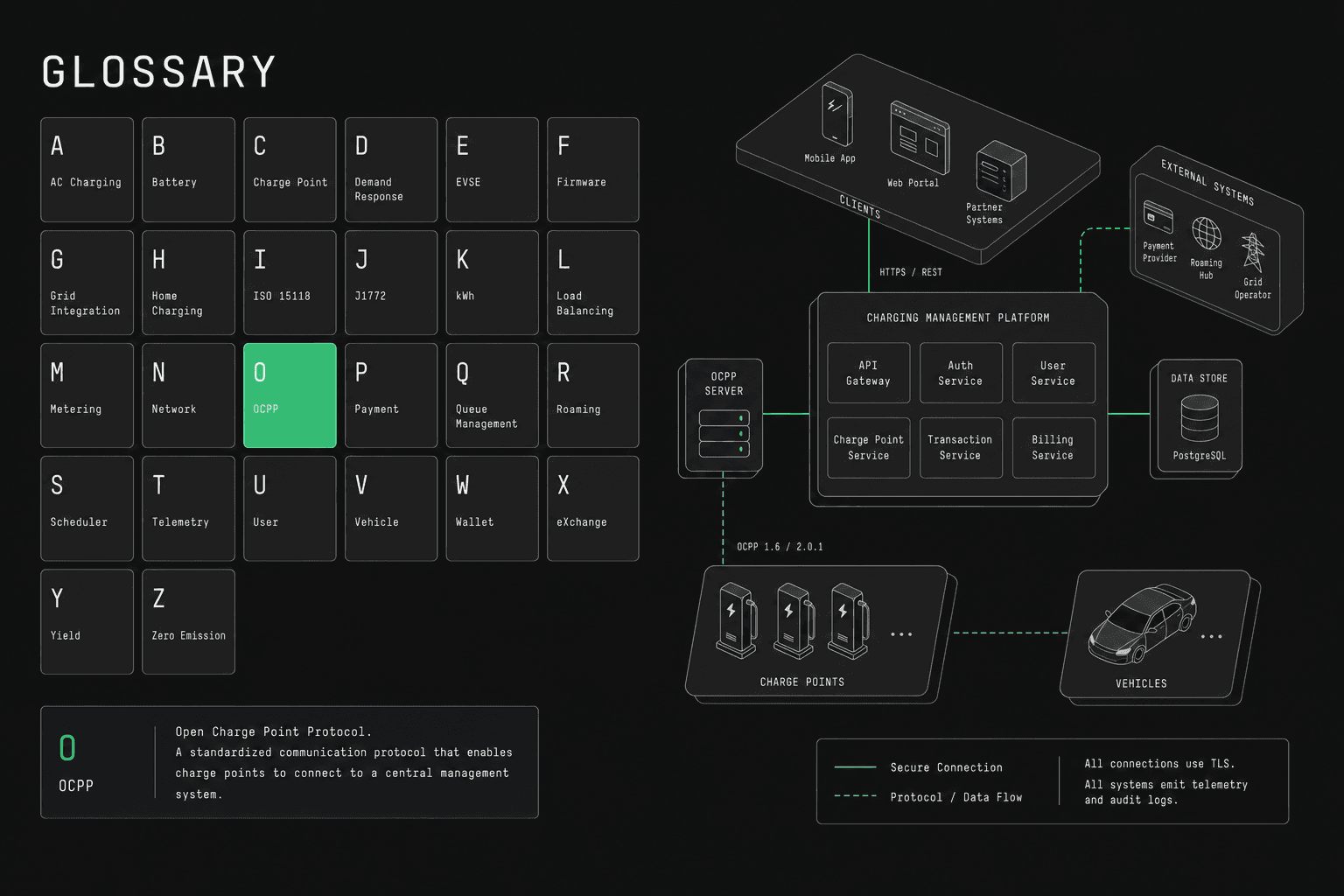
The backend software platform that manages a network of EV chargers via OCPP. Handles authorization, billing, monitoring, and remote operations.
D
DC Fast Charging
Charging an EV using direct current, bypassing the vehicle's onboard charger. Delivers substantially higher power than AC, which can charge a battery in tens of minutes rather than hours, making it common at highway and rapid-charging sites.
Demand Response
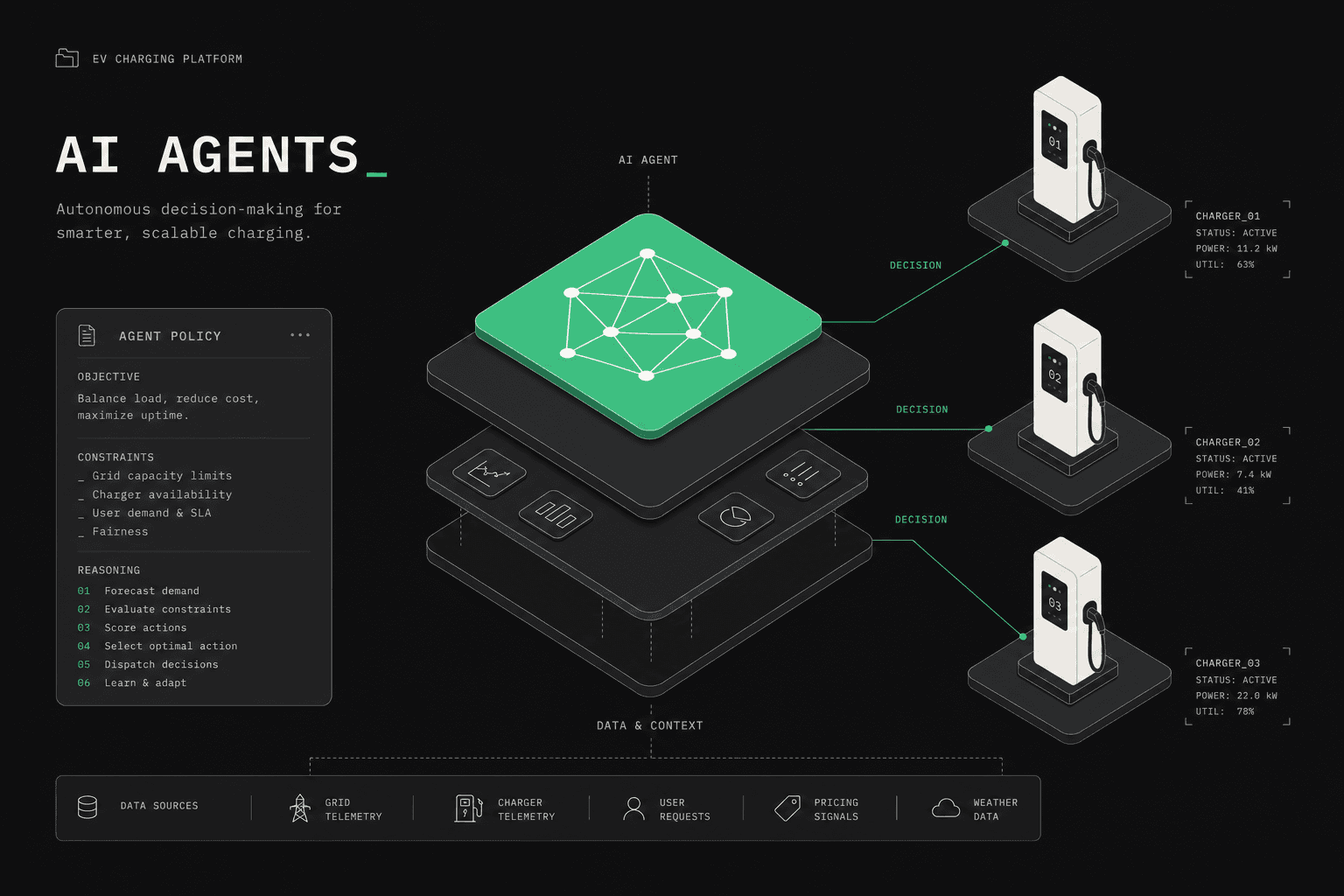
Programs where charging is adjusted based on grid conditions. During peak demand, charging power is reduced. During surplus (e.g., high solar/wind production), charging is increased.
E
eMSP (e-Mobility Service Provider)
A company that provides EV drivers with access to charging stations. Offers apps, RFID cards, and billing. Connects to CPOs via OCPI for roaming.
EVSE (Electric Vehicle Supply Equipment)
Technical term for an EV charging station. Includes the charger, connector, cable, and safety systems.
G
GIREVE
A major EV charging roaming hub in Europe. Connects a large number of CPOs and eMSPs via OCPI, enabling cross-network charging access.
H
Heartbeat
A periodic OCPP message sent by a charger to its CPMS to confirm the connection is alive. The interval is set by the CPMS in the BootNotification response.
Hubject
A global roaming platform for EV charging. Uses both OCPI and its proprietary OICP protocol. Known for its Plug&Charge PKI infrastructure.
I
IdTag
In OCPP 1.6, the identifier used to authorize a charging session. The OCPP 1.6 specification defines it as a string of up to 20 characters, representing an RFID card UID, app token, or other identifier.
ISO 15118
International standard for communication between EVs and chargers. Enables Plug and Charge (automatic authentication) and Vehicle-to-Grid (V2G). The bidirectional power transfer requirements are defined in ISO 15118-20.
L
Load Balancing
Distributing available electrical capacity across multiple chargers to prevent circuit overload. Can be static (fixed limits) or dynamic (real-time adjustment based on actual consumption).
M
MeterValues
OCPP message containing energy meter readings from a charger. Includes data like energy consumed (Wh), power (W), voltage (V), current (A), and state of charge (%).
O
OCA (Open Charge Alliance)
The organization that develops and maintains the OCPP protocol. Members include charger manufacturers, CPMS vendors, and energy companies.
OCPI (Open Charge Point Interface)
Open protocol for EV charging roaming. Enables data exchange between CPOs and eMSPs for cross-network charging. Current version: 2.2.1.
OCPP (Open Charge Point Protocol)
Open standard for communication between EV chargers and CPMS backends. Uses WebSocket transport with JSON messages. Current versions: 1.6 and 2.0.1.
OICP (Open InterCharge Protocol)
Hubject's proprietary roaming protocol. Alternative to OCPI for connecting CPOs and eMSPs.
P
Peak Shaving
Reducing power consumption during periods of high grid demand by lowering charging power or pausing sessions temporarily.
Plug and Charge
Automatic authentication when an EV is plugged into a charger. No app or RFID needed. Enabled by ISO 15118 and OCPP 2.0.1.
R
RemoteStartTransaction
OCPP message sent from CPMS to charger instructing it to begin a charging session. Used when a driver starts charging via a mobile app.
Roaming
The ability for EV drivers to charge on any network using a single account or app. Enabled by OCPI or OICP protocols.
S
Smart Charging
Optimizing EV charging based on grid capacity, energy prices, renewable energy availability, or user preferences. Managed via OCPP charging profiles.
StatusNotification
OCPP message sent by a charger to report its current status: Available, Preparing, Charging, SuspendedEV, SuspendedEVSE, Finishing, Reserved, Unavailable, or Faulted.
T
TLS (Transport Layer Security)
Encryption protocol used to secure OCPP WebSocket connections. OCPP 2.0.1 defines three security profiles with increasing TLS requirements.
V
V2G (Vehicle-to-Grid)
Technology enabling EVs to send stored energy back to the electrical grid. Requires bidirectional chargers and ISO 15118-20 support.
W
WebSocket
The transport protocol used by OCPP for persistent, bidirectional communication between chargers and CPMS. Enables real-time message exchange without polling.
Test Your Knowledge
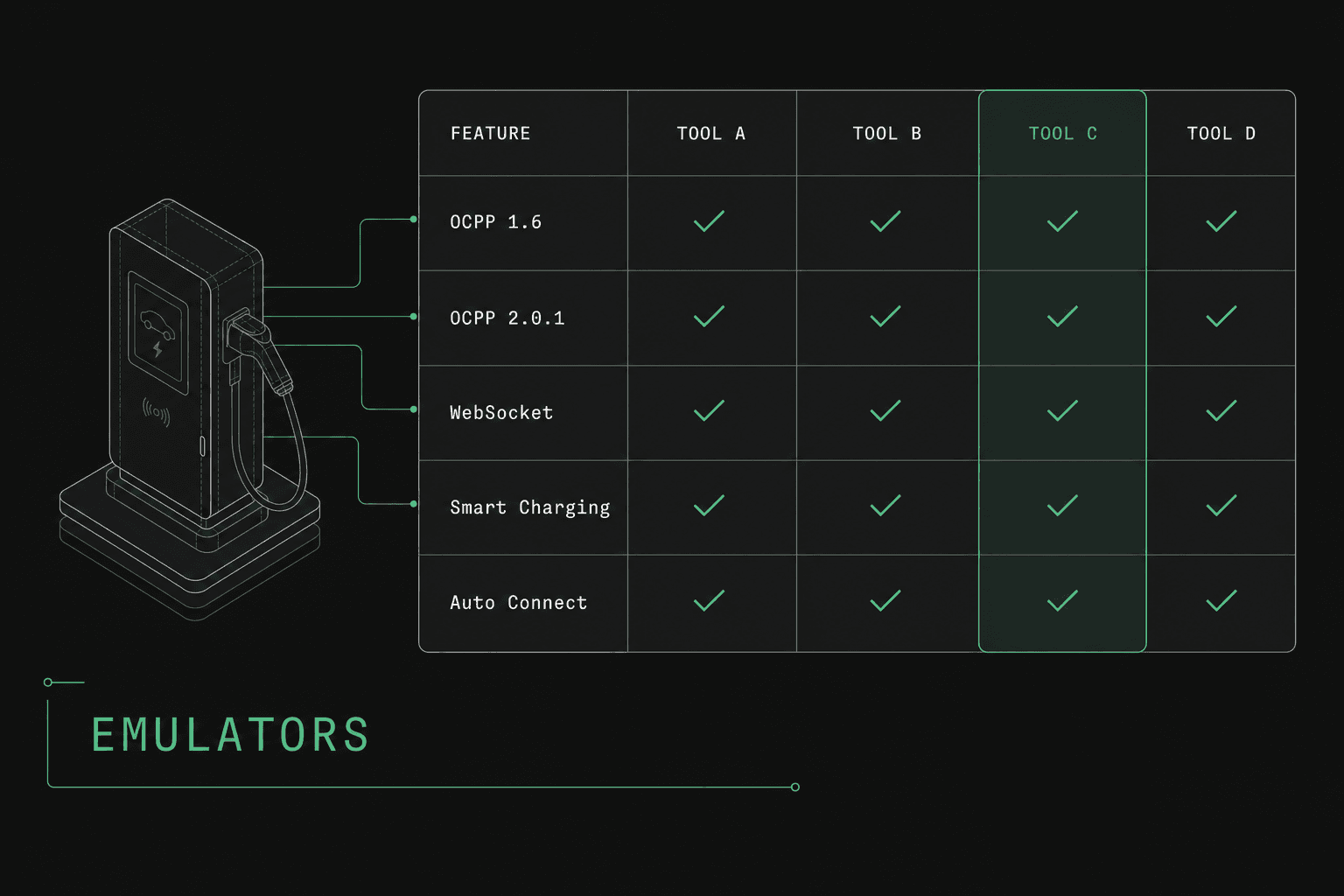
Ready to put these concepts into practice? OCPPLab lets you simulate the entire EV charging ecosystem — deploy virtual chargers, test OCPP/OCPI flows, and validate your CPMS implementation.